
The AND Life: How Entrepreneurs Can Scale Without Sacrificing Family
You Did Not Build Your Business for Freedom Only to Become Unavailable to Your Own Life
Most entrepreneurs do not start a business because they want more pressure.
They start because they want freedom.
Freedom to provide.
Freedom to lead.
Freedom to create impact.
Freedom to design a life with more meaning, more choice, and more time with the people they love.
But somewhere along the way, many business owners find themselves living the opposite.
They have more clients, more responsibility, more revenue, and more opportunity — but less peace, less presence, and less room to breathe.
Dinner is interrupted by messages.
Rest feels irresponsible.
Even family time carries the weight of unfinished decisions.
From the outside, the business may look successful.
But inside, the entrepreneur is thinking:
“I am doing everything myself.”
“I cannot step away.”
“No one can do it like me.”
“I want to grow, but I do not have the capacity.”
“I built this business for freedom, but it still owns my time.”
This is what happens when entrepreneurs start living the OR Life.
Business or family.
Growth or peace.
Money or time.
Success or health.
Ambition or presence.
But that was never supposed to be the choice.
The real issue is not that you want too much.
The real issue is that your business may not yet be designed to support the life you actually want.
That is where the AND Life begins.
What Is the OR Life?
The OR Life is the belief that success requires you to sacrifice the things that matter most.
It sounds responsible at first.
You tell yourself:
“Once I reach this revenue goal, I will slow down.”
“Once this launch is over, I will rest.”
“Once I hire someone, I will be more present.”
“Once the business is stable, I will make more time for my family.”
But the season keeps stretching.
There is always another client.
Another fire. Another decision. Another deadline. Another issue only you can solve.
And slowly, sacrifice becomes normal.
You become the person everyone waits for. You become the approval point. You become the quality control. You become the backup plan. You become the system.
That is not freedom.
That is founder dependency wearing the mask of success.
A business that depends on you for everything will eventually compete with everything else you care about:
Your marriage. Your children. Your health. Your peace. Your creativity. Your ability to lead with clarity.
The OR Life convinces entrepreneurs that this is simply the price of success.
But it is not.
It is the result of a business structure that needs to evolve.
The Hidden Cost of Founder Dependency
Most entrepreneurs are not exhausted because they lack discipline.
They are exhausted because they are carrying too much.
They are still making too many decisions. They are still solving too many problems. They are still checking too many details. They are still holding too much knowledge in their head. They are still operating as the center of the business instead of the leader of the business.
And when everything depends on the founder, growth becomes expensive.
Not just financially.
Emotionally. Physically. Relationally. Mentally.
The stress does not stay inside the business.
It follows you home.
It shows up when you are physically present with your family but mentally reviewing client work.
It shows up when you feel guilty for resting.
It shows up when your children are speaking but your attention is divided.
It shows up when success feels heavy instead of fulfilling.
Research has consistently shown that work-family conflict affects work outcomes, family outcomes, and overall well-being.
In simple terms, when business pressure consumes your emotional capacity, the people closest to you feel the cost.
This is why the conversation cannot only be about productivity.
It has to be about design.
Because you cannot create an AND Life with an OR Life business model.
What Is the AND Life?
The AND Life is the belief that entrepreneurs do not have to choose between success and what matters most.
You can build wealth and protect your family.
You can grow your business and have peace.
You can lead with ambition and be present at home.
You can create impact and have room to breathe.
You can scale and stop doing everything yourself.
The AND Life is not about avoiding hard work.
It is about refusing to build a business that only survives through overwork.
It means you stop treating burnout as proof of commitment.
You stop confusing control with leadership.
You stop measuring success only by revenue while ignoring the cost to your life.
The AND Life requires a higher standard.
A better structure.
A stronger team.
Clearer systems.
More intentional delegation.
A founder who is willing to lead instead of simply operate.
Because success should not cost your life.
It should help fund it, protect it, and expand it.
Why Entrepreneurs Stay Stuck in the OR Life
Most entrepreneurs do not stay stuck because they want to.
They stay stuck because the business was built around them.
In the beginning, that is normal.
You are the founder.
You carry the vision.
You know the clients.
You know the standards.
You know how things should be done.
At the start, your involvement helps the business grow.
But at a certain stage, the same strength that helped you build the business can become the thing that limits it.
If every decision needs you, the business cannot move without you.
If every process lives in your head, your team cannot fully support you.
If every standard requires your personal review, quality cannot scale.
If every problem comes back to you, leadership becomes exhaustion.
This is where many entrepreneurs need more than help.
They need a leadership shift.
An operator asks:
“How can I get this done?”
A leader asks:
“Who can own this, and what system will help them succeed?”
That one shift changes everything.
Because the goal is not to keep proving that you can do everything.
The goal is to build a business that no longer requires you to.
Delegation Is Not Losing Control
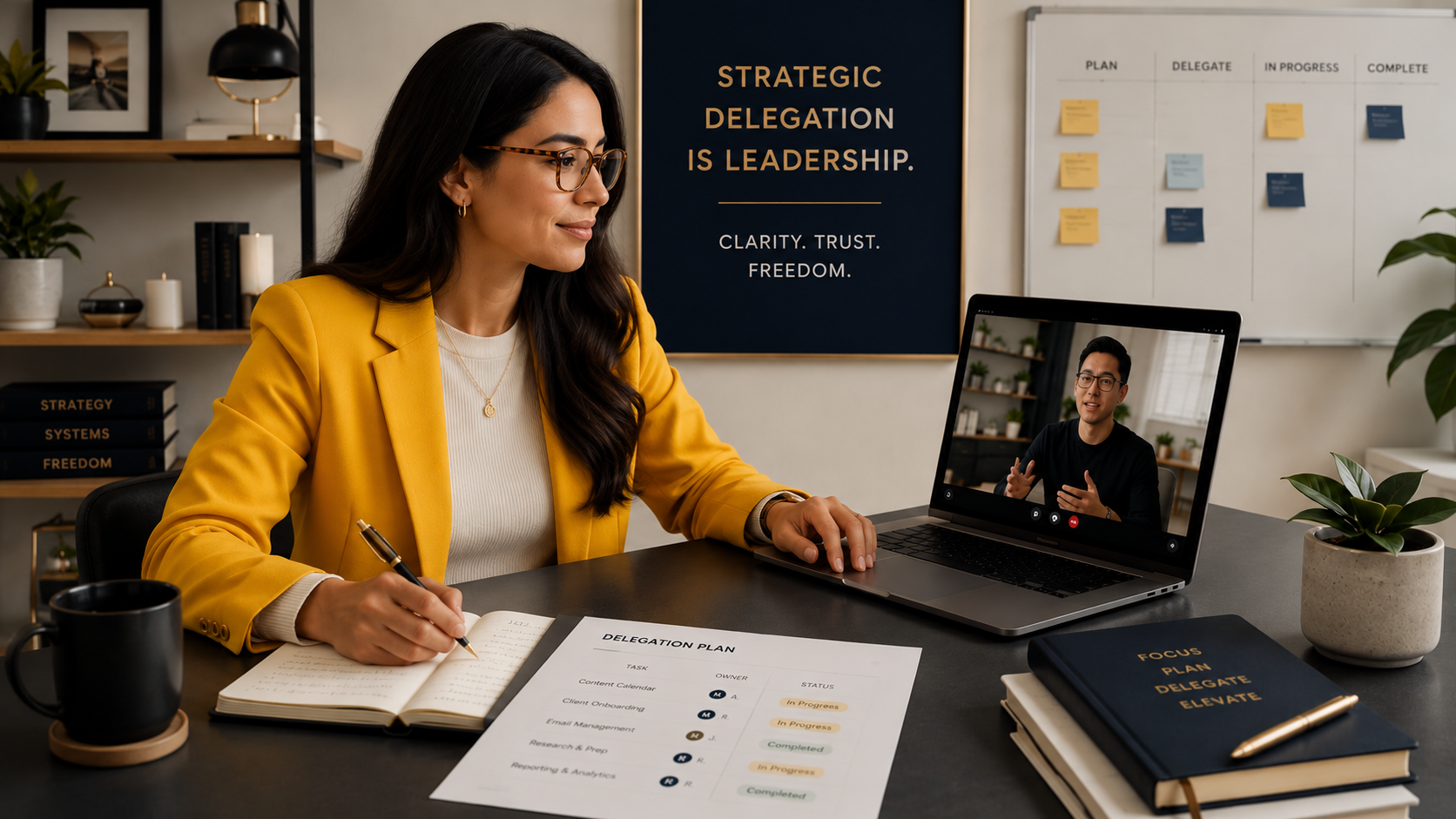
One of the biggest reasons entrepreneurs stay overwhelmed is because they misunderstand delegation.
They think delegation means giving up control.
But real delegation is not dumping tasks.
It is not hiring someone and hoping they figure it out.
It is not handing off responsibility without direction.
It is not lowering your standards.
It is not disappearing from leadership.
Real delegation is leadership.
It means you define the outcome.
You communicate the standard.
You document the process.
You train with clarity.
You give ownership with accountability.
You trust people to execute inside a structure that supports excellence.
When done correctly, delegation does not weaken quality.
It protects it.
It gives your team clarity.
It gives your business consistency.
It gives you capacity.
It gives your family access to the version of you that is not constantly drained.
This is the difference between hiring help and building leverage.
Help removes a task.
Leverage creates freedom.
I believe delegation is not about doing less. It is about leading at a level where the business no longer depends on your exhaustion. At Virtual Dream Team, that belief shapes how we help entrepreneurs build the support, systems, and structure they need to lead with more clarity and less overwhelm.
The goal is not simply to place a VA into a busy business.
The goal is to help entrepreneurs build the support structure that allows them to lead better, scale smarter, and reclaim time for the life they are actually building.
7 Signs You Are Living the OR Life
You may be living the OR Life if:
You feel guilty when you rest.
You check your phone during family time.
You believe everything will fall apart if you step away.
You keep saying, “It is faster if I do it myself.”
Your team waits for you before making decisions.
You are physically present at home but mentally still inside the business.
You have business growth, but not personal freedom.
If several of these feel familiar, it does not mean you have failed.
It means your business is ready for a better structure.
The next level of growth will not come from carrying more.
It will come from leading differently.
7 Ways to Move From the OR Life to the AND Life
1. Name What You Are Tired of Choosing Between
Before you can change the pattern, you have to name it.
What choice has been quietly exhausting you?
Business or family?
Growth or peace?
Clients or health?
Revenue or rest?
Success or marriage?
Ambition or presence?
When you name what your current business structure is costing you, you can finally begin designing something better.
2. Identify Where You Are Still the Bottleneck
Look honestly at your week.
Where do tasks stop because you are unavailable?
Where does your team wait for approval?
Where do clients still depend on your personal involvement?
Where do you keep stepping back into work someone else should own?
These are bottlenecks.
And bottlenecks are not just operational issues.
They are freedom issues.
If you want more capacity, you have to identify the places where the business still cannot move without you.
3. Create a Stop-Doing List
Most entrepreneurs have a to-do list.
Very few have a stop-doing list.
But freedom often begins with subtraction.
Write down the tasks, meetings, decisions, and responsibilities that should no longer require your founder-level energy.
This becomes your delegation map.
The goal is not to abandon responsibility.
The goal is to stop giving founder-level energy to tasks that no longer require founder-level involvement.
4. Document One Repeatable Process This Week
You do not need to systemize your entire business overnight.
Start with one repeatable process, such as client onboarding, inbox management, lead follow-up, content scheduling, weekly reporting, customer support, or appointment setting.
Then document it simply.
Record a short video.
Write a checklist.
Clarify the standard.
Define what “done well” looks like.
A business becomes scalable when knowledge stops living only in the founder’s head.
Systems are not about making the business cold or rigid.
They are about creating consistency, trust, and freedom.
5. Delegate Outcomes, Not Just Tasks
Weak delegation sounds like this:
“Handle my inbox.”
Strong delegation sounds like this:
“I need my inbox organized so urgent client messages are answered quickly, low-priority messages are filtered, and I only see what truly needs my decision.”
The difference is clarity.
Tasks tell people what to do.
Outcomes help people understand what matters.
When you delegate outcomes, you give your team a higher level of ownership and reduce the amount of supervision required because expectations are clear from the beginning.
This is where delegation becomes leadership.
6. Protect Family Time Like a Business Commitment
If family is part of your definition of success, it has to be protected in your calendar.
Not hoped for.
Protected.
Block dinner time.
Block school events.
Block date nights.
Block rest.
Block personal care.
Block space to be fully present.
Your calendar reveals what your business is truly built around.
If your life only receives leftover time, the business will always take more than it should.
7. Shift From Operator Identity to Leader Identity
The hardest part of delegation is not always the task handoff.
Sometimes it is the identity shift.
Many entrepreneurs are used to being the person who figures everything out.
That identity helped them survive the early stages of business.
But what helped you start may not help you scale.
The next level requires better questions:
Who can own this?
What system would make this easier?
What standard needs to be clearer?
What decision can I train someone else to make?
What am I holding onto because I do not fully trust yet?
Freedom is not only a business strategy.
It is a leadership identity.
You stop being the person who carries everything.
You become the person who builds the structure, team, and standards that allow the business to grow beyond you.
The New Standard of Success
For years, entrepreneurs were praised for being busy.
Busy meant important.
Overworked meant committed.
Exhausted meant serious.
But that standard is outdated.
The new standard of success is not how much you can carry.
It is how intentionally you can lead.
It is not how many hours you work.
It is how much freedom your business creates.
It is not how dependent your team is on you.
It is how clearly your business can move with the right people, the right systems, and the right leadership.
Because the goal is not to build a business that looks successful while your personal life quietly suffers.
The goal is to build a business that funds your dream life, protects your family, honors your health, and gives you space to become the person you were called to be.
That is the AND Life.
And you are allowed to want it.
You are allowed to want success and family.
You are allowed to want money and peace.
You are allowed to want growth and rest.
You are allowed to want impact and presence.
You do not need to choose less.
You need to build differently.
Ready to Stop Being the Bottleneck in Your Own Business?
If your business depends on you for every decision, every task, and every detail, growth will always come with a cost.
But it does not have to stay that way.
Virtual Dream Team helps entrepreneurs build the support, systems, and delegation structure they need to scale without sacrificing their family, health, or peace.
The right support does more than save time.
It helps restore your leadership capacity.
It gives your business room to grow.
It gives your team the clarity to move without waiting on you.
It gives you space to be fully present for the life you are building the business to protect.
If you are ready to stop carrying everything alone, it may be time to build the right team behind you.
Start building your AND Life with Virtual Dream Team.

FAQ: The OR Life vs. the AND Life
What does the OR Life mean for entrepreneurs?
The OR Life is the belief that entrepreneurs must choose between business success and personal fulfillment. It often shows up as choosing between money or time, growth or peace, business or family, and ambition or health.
What is the AND Life?
The AND Life is the belief that entrepreneurs can build success while protecting what matters most. It means designing a business that supports family, freedom, health, wealth, purpose, and peace.
How can entrepreneurs stop sacrificing family for business?
Entrepreneurs can start by identifying where the business depends too heavily on them, documenting repeatable systems, delegating intentionally, and building support that allows the business to move without constant supervision.
Can delegation really help with work-life balance?
Yes. Delegation can help entrepreneurs reduce founder dependency, protect their time, and focus on higher-value leadership activities. But delegation works best when it is supported by clear systems, communication, expectations, and trust.
Why do entrepreneurs struggle to delegate?
Many entrepreneurs struggle to delegate because they believe it is faster to do things themselves, they fear quality will drop, or they are used to being the person everything depends on. The solution is not random hiring. The solution is clear outcomes, documented systems, and better leadership.
References
Allen, T. D., Herst, D. E. L., Bruck, C. S., & Sutton, M. (2000). Consequences associated with work-to-family conflict: A review and agenda for future research. Journal of Occupational Health Psychology, 5(2), 278–308.
Amstad, F. T., Meier, L. L., Fasel, U., Elfering, A., & Semmer, N. K. (2011). A meta-analysis of work-family conflict and various outcomes with a special emphasis on cross-domain versus matching-domain relations. Journal of Occupational Health Psychology, 16(2), 151–169.
Kossek, E. E., Pichler, S., Bodner, T., & Hammer, L. B. (2011). Workplace social support and work-family conflict: A meta-analysis clarifying the influence of general and work-family-specific supervisor and organizational support. Personnel Psychology, 64(2), 289–313.